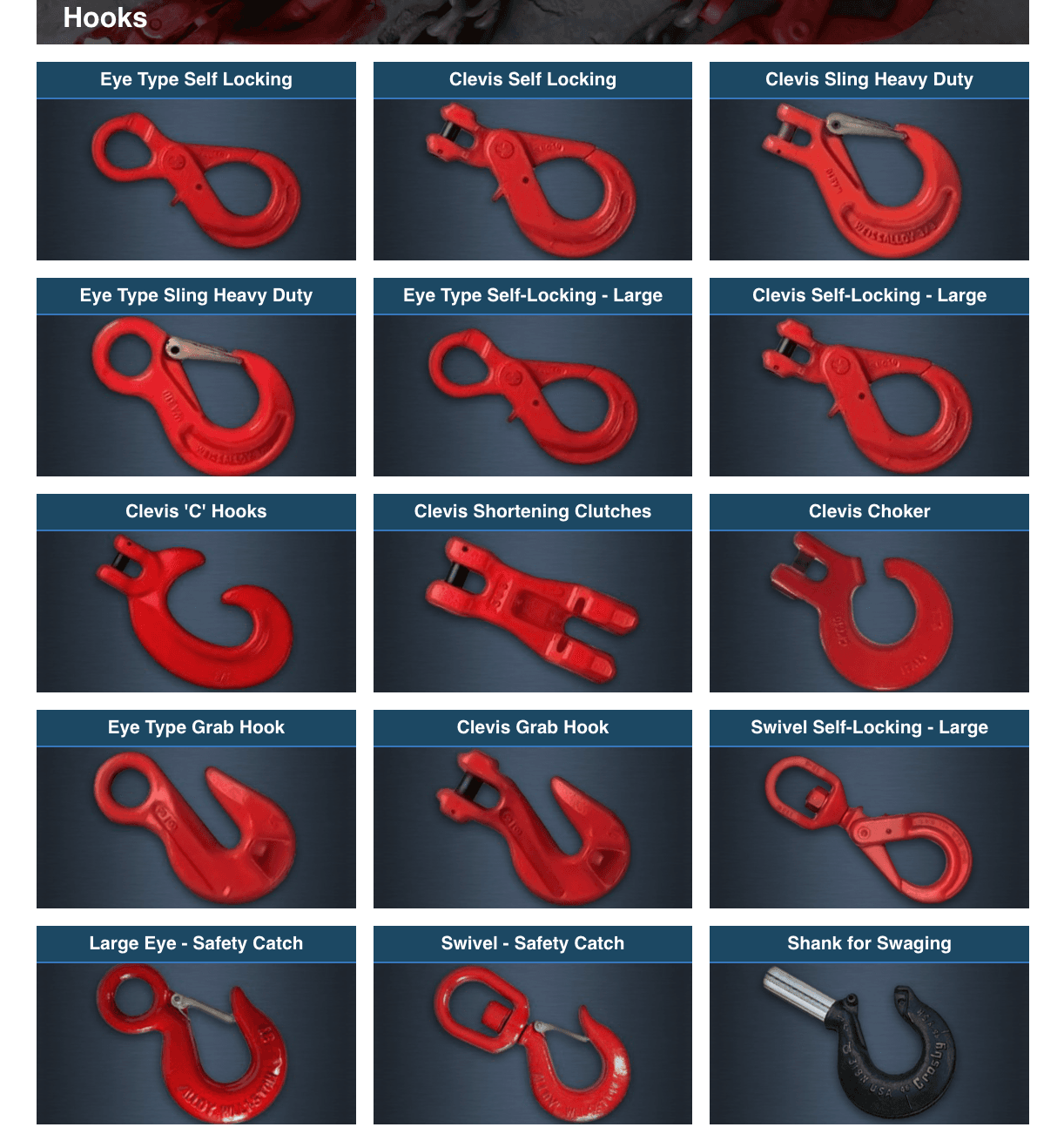
Lifting Hooks
We supply a comprehensive range of industrial lifting hooks manufactured from high-grade forged alloy steel (Grade 80). Our hook range includes over 20 different types: clevis hooks, eye hooks, swivel hooks, self-locking safety hooks, grab hooks, choker hooks, sling hooks (heavy duty), carbine hooks with various eyelet configurations, and shank hooks for swaging. All hooks feature safety latches or self-locking mechanisms to prevent accidental disengagement. Each hook is individually marked with Working Load Limit (WLL), batch tested, and certified for safety. Suitable for chain slings, wire rope slings, and direct lifting applications.
For bulk orders and custom requirements:
Hook Types Available
Applications
Frequently Asked Questions
What is the difference between clevis and eye type hooks?
Clevis hooks have a U-shaped end with a pin that allows quick attachment and detachment from chain slings. Eye hooks have a closed circular eye that requires the sling to be threaded through or connected via a link, making them more suitable for permanent installations.
How do self-locking hooks work?
Self-locking hooks have a spring-loaded latch that automatically closes when a load is applied. The hook cannot open while under load, providing automatic safety. To release, the load must be removed and the latch manually opened.
When should I use a swivel hook?
Swivel hooks are used when the load needs to rotate during lifting without twisting the sling or rope. They have a bearing that allows 360° rotation under load, preventing torque buildup in multi-leg sling assemblies.
What is a grab hook used for?
Grab hooks are designed to grab onto a chain link to shorten the effective length of a chain sling leg or to create an adjustable connection point. They are not for direct load lifting but for chain adjustment.
Why is the safety latch important?
The safety latch prevents the sling or load from accidentally slipping out of the hook throat during lifting operations. It's a critical safety feature required by most safety regulations including OSHA and EN standards.
Can hooks be repaired if damaged?
No, damaged hooks should never be repaired. If a hook shows cracks, deformation, throat opening exceeding 15% of original, or wear exceeding 10% of original dimensions, it must be removed from service and destroyed.
What does Grade 8 (G80) mean for hooks?
Grade 8 indicates the strength level of the alloy steel. G80 hooks have a Minimum Breaking Load (MBL) of 4 times the Working Load Limit (WLL). This provides a 4:1 safety factor as required by EN 1677-2 standard.